
Enhanced Compliance and Controls with AI
Make compliance and controls faster, more scalable and more robust with AI.


Financial services firms have never shied away from ambitious technology programs. From RPA to digital, cloud to data, the sector has repeatedly invested at scale. Yet, despite significant investment and effort, many of these transformations have not fully delivered on their strategic promise and ambitious investment returns. So what can be learned from the challenges of past transformations as firms look to embed AI in their businesses?
When projects fail to deliver it is rarely about a lack of effort, funding or technology, but because too much attention is paid to the visible layers such as tools, pilots and performance targets and too little on the deeper foundations of change like process change, cultural behaviors and governance. AI represents another transformation opportunity, but to fully realize its potential firms must learn from the patterns that have impeded previous transformation initiatives.
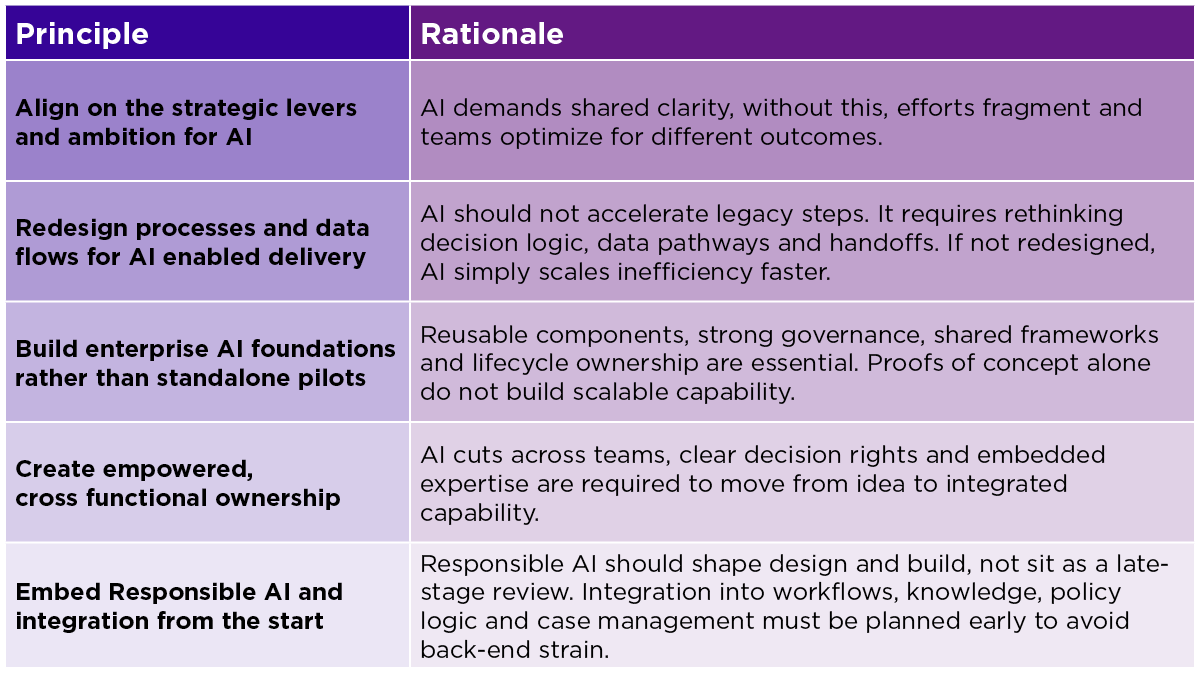
These principles are not new. Financial services firms have seen variations on these themes through previous transformation efforts.
The promise of RPA was simple and attractive – keep your existing processes and let bots handle the work. In many organizations, this became a justification for avoiding deeper redesign. Bots mimicked human steps rather than challenging their necessity. The result was faster execution, not better outcomes.
Sound familiar? Agents and assistants are being added to existing pathways without questioning whether the pathway itself still makes sense. If data structures, decision logic and handoffs remain untouched, AI risks becoming a more powerful version of RPA’s workaround model: quicker but still constrained by the same flaws.
Our recommendation: Before deploying agents, re-engineer the process. Begin by identifying decisions that are frequent, fragmented, and heavily manual. Map the data, policy, and exception logic that underpin them. Crucially, challenge whether the process itself is designed in the right place. Don’t just automate existing steps. Redesign the journey, restructure inputs, and reframe checkpoints to amplify the value AI can unlock.
Financial services organizations have built vast data estates, many with strong architectural foundations. But the gap between data capabilities and business outcomes still exists. Teams pursued different priorities, built competing assets and measured success in inconsistent ways. Investments expanded the technology footprint rather than improving outcomes.
Familiar pitfalls. The same pattern can be seen with AI, with teams developing promising prototypes without alignment on shared priorities, data standards or integration patterns – each operating in their own bubble. However, what looks effective in isolation becomes hard to scale across an enterprise that is not aligned in the same direction.
Our recommendation: Shift AI from exploration to execution by being explicit about the choices that will shape your organization’s AI ambition. Provide your teams the clarity needed to avoid fragmented experimentation and ensure AI efforts build towards a coherent enterprise direction rather than scattered activity.
Agile promised adaptability and speed, but implementation has often skewed towards the cosmetic. Job titles changed, ceremonies launched, but without sustained investment in mindset, skills, and governance, delivery often slowed rather than accelerated, resulting in Agile leads running waterfall projects.
AI warning signs. Setting up ‘AI Leads’ or pilot squads without clear mandates, ownership models and change support can unintentionally replicate legacy patterns in new language.
Our recommendation: Don’t just appoint AI Leads – give them real authority. Define their mandate to cut across delivery, risk and change. Pair these leads with enablers (e.g. data engineers, policy SMEs, model risk) to create cross-functional teams that can move from concept to capability fast.
Digital investments transformed customer interfaces, but too often they masked brittle back-end processes. Seamless UX faltered when it hit approvals running on spreadsheets.
Déjà vu? Customer-facing AI assistants are being launched with promise, but without deep integration across workflow, knowledge, and decision rules, experience breaks at the point of complexity.
Our recommendation: Make integration your first priority, not your last. Create an AI integration playbook covering how AI solutions plug into knowledge bases, workflow engines, policy rules and CRM or case management. No AI initiative should go live without two-way orchestration built in.
Financial services institutions have typically rarely lacked ambition nor discipline, but transformation initiatives too often falter as a result of organizational barriers, siloed funding models and overly rigid hierarchies.
AI is now bringing these challenges to the surface much earlier. Because the pace of change is so rapid, many organizations begin with pilots that demonstrate what is possible, but not what is operational. As soon as they attempt to scale, the same structural issues that hampered previous transformations reappear in sharper form, exposing cracks in architecture, governance, data and process.
Even so, there are clear signs that some firms are taking a more deliberate path and learning from past transformations, where:
These organizations recognize AI as an operating model and architecture shift, not a tooling upgrade.
Across previous waves of financial services transformation, one theme recurs: organizations often moved quickly on delivery, but far more slowly on aligning leaders around the strategic choices that shape how transformation should unfold.
RPA was launched without agreement on the role automation should play. Cloud migrations advanced without clarity on ownership, pace or risk appetite. Digital investments scaled without a shared view of where value should land. The end result was invariably fragmentation, duplicated investment and inconsistent expectations about what constituted success.
This is where a structured approach to strategic alignment becomes critical. Before scaling AI, organizations need a shared view on the decisions that will shape how AI delivers value. These choices are not tactical; they set the direction for investment, governance, operating model design and how teams make day-to-day trade-offs.
Capco’s Strategic Levers Assessment provides this alignment. Rather than evaluating technical maturity, it helps leadership teams define the strategic position that will guide how AI is explored, governed and scaled. It creates clarity on:
These decisions serve as a compass for the entire AI portfolio. They reduce friction, provide a common language across technology, data, business and risk, and ensure experimentation builds towards a coherent enterprise direction rather than scattered activity.
AI presents a real opportunity for financial services institutions to be leaders, not followers. Progress will not come from experimentation alone, however, but also from clarity around ambitions, honesty about readiness, and discipline in executing across the enterprise.
The firms that succeed will be those that build on their existing strengths, recognize any new foundations they may need to put in place, and then move with deliberate intent. AI rewards focus, not frenzy. Now is the moment to choose a different path and deliver transformation that lasts.


