AI is not just another technology; it is a transformation engine. But as financial institutions look to harness AI at scale, it is becoming clear that traditional data architecture won’t get us there and a new shift is needed from data architecture to
AI-ready knowledge architecture - a framework where data is not just stored or queried but understood.
This paper outlines the strategic pathway to becoming an AI-ready enterprise and details the approach for achieving that transformation.
Traditional data architecture: what got us here
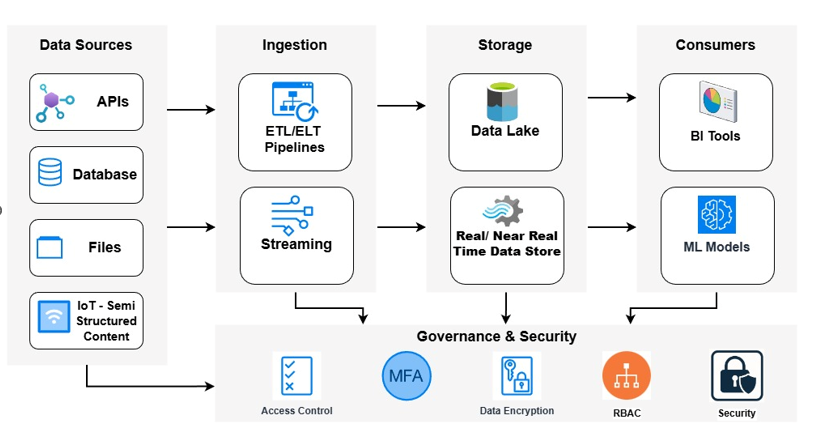
For decades, financial services firms have relied on centralized data ecosystems optimized for accuracy, compliance, and reporting efficiency.
Despite its strengths, traditional data architecture faces critical limitations when scaled towards AI-driven operations:
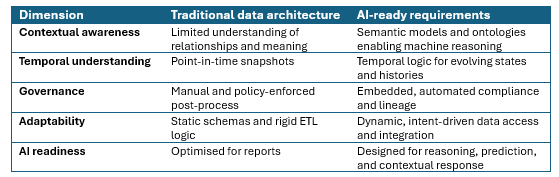
AI-ready knowledge architecture: the new paradigm
AI does not just require clean, governed data — it requires context, meaning, and a grasp of how information evolves. It must know what changed, when it changed, why it changed, and how that information links across processes, products, and time.
Forward-thinking financial institutions are already moving toward a new blueprint: one that doesn’t simply store data but architects it for machine reasoning. This shift marks the evolution from traditional data architectures—built for reporting and analytics—to knowledge architectures, which are built for intelligence.
Focus is shifting towards designing dynamic, context-aware knowledge systems that supports and leverages copilots, autonomous agents, and real-time decision engines. These systems allow AI to interpret relationships, infer meaning, and activate the real-time right insights.
This is why the transition from data architecture to knowledge architecture is not optional. It is foundational.
Knowledge architecture: key capabilities required to be AI ready
Knowledge architecture represents the next evolution—an ecosystem where data, logic, and policy co-exist. It builds on traditional foundations but adds layers of semantics, temporal awareness, and policy automation.
Key principles:
- Data is contextualized, not just cleansed
- Policies and lineage are codified, not documented
- Knowledge is queried by intent, not schema.
- AI interacts with data through semantic and temporal reasoning.
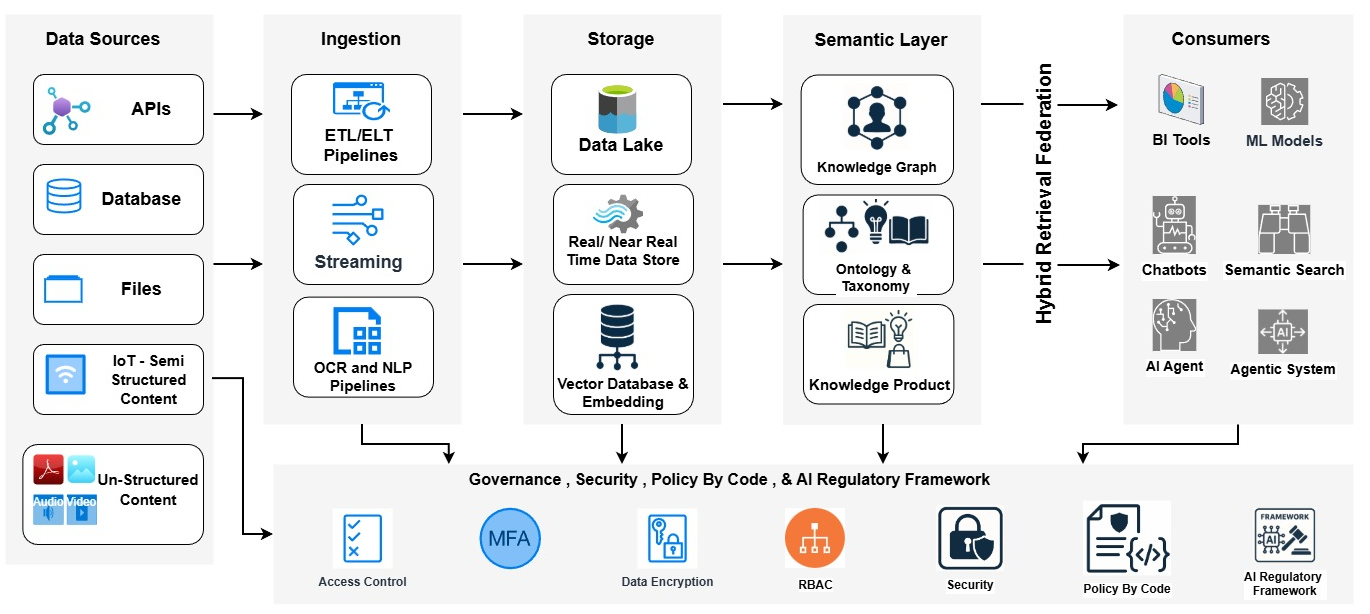
Key building blocks of AI-ready knowledge architecture:
1. Embedded data management
In a world of AI-generated decisions, transparency and explainability are non-negotiable. By embedding policies directly into data contracts and execution pipelines, organizations can codify governance into runtime systems. AI also requires high-integrity inputs that starts with embedding data quality, metadata, lineage, and access control into the core of every pipeline.
Core capabilities
- Turn compliance requirements into executable logic
- Shift from manual data stewardship to automated policies
- Enable lineage tracing across the full data lifecycle
- Automate control enforcement and traceability
- Enable real-time policy validation and audit trails.
Outcomes
- Built-in compliance and explainable AI at scale
- Trusted data flows that power reliable, auditable AI.
2. Domain-centric knowledge products
Each domain owns knowledge products that are designed around questions, not schemas to enable AI find answers not just data. Modern knowledge architecture decentralizes ownership to business domains, who define and maintain knowledge products which are a collection of data, logic, and policy designed to answer specific business questions.
Core capabilities
- Use ‘knowledge contracts’ to define what each product delivers
- Align with SLAs, semantics, and business intent
- Allow AI agents to query by intent, not schema.
Outcome
Products that are actionable, reusable, and intelligible to both humans and machines.
3. Knowledge fabric
This is the connective tissue of your knowledge ecosystem, a semantic layer that unifies structured, semi-structured, and unstructured data into a machine-readable format using ontologies, temporal logic, and graph relationships. This is where true interoperability and machine understanding begins.
Core capabilities
- Support hybrid retrieval combining vectors, graphs, and temporal indexes
- Enable multi-hop reasoning and contextual augmentation
- Connect disparate sources into a cohesive semantic layer.
Outcome
A platform where AI agents can safely navigate and retrieve meaning with precision and context.
4. Unified digital and data foundation
Perhaps the most critical, and often overlooked, element is the integrated architecture that binds digital and data capabilities into one coherent foundation.
This is where operational systems (CRM, core banking, risk engines) and analytical engines (AI models, BI, analytics) come together with shared semantics, integration standards, and architectural blueprints. This is the shared nervous system of organization's AI ecosystem that ensures every part of the business can speak the same language, adapt to change and scale with confidence.
One of the potential recommendations to achieve this unification is to implement the Model Context Protocol (MCP), which will lay the foundation for evolving from static interoperability to dynamic orchestration — enabling seamless, policy-compliant communication between data systems, knowledge products, and AI-driven interfaces.
Core capabilities
- Define common patterns for data and digital integration
- Harmonize terminology across tools, platforms, and domains
- Create reusability and extensibility across future use cases
- Integrate safety and observability so all AI actions, model interactions and user sessions within the MCP layer are auditable, explainable, and aligned to governance policies.
Outcome
A policy-aligned, context-orchestrated foundation that connects digital and data capabilities, enabling trusted, scalable, and intelligent automation across the enterprise.
The payoff: becoming an AI-ready enterprise
An AI-ready architecture is not just a tech uplift; it is a business transformation. When these building blocks are in place, firms unlock:
- Scalable innovation: rapid AI use case deployment across domains
- Built-in compliance: explainable AI with embedded governance
- Operational trust: end-to-end lineage and policy transparency
- Reusability: knowledge assets adaptable across business functions.
Most importantly, an AI-ready architecture is the foundation for moving from isolated AI pilots to enterprise-grade adoption.
How Capco can help
Capco helps clients define and implement these architectures through knowledge product design, semantic modelling, policy automation, and integrated data/digital strategies.
Please contact us to find out more.