
Regulation


As discussed in the first article of this series on the EU prudential simplification agenda, European authorities are increasingly assessing whether regulatory complexity delivers sufficient prudential value. The European Banking Authority’s (EBA) credit risk discussion paper represents one of the first concrete applications of this agenda and provides an early indication of how simplification could be implemented in practice.1 The EBA is examining where existing requirements may create unnecessary implementation, reporting and supervisory burdens, and whether a better balance can be achieved between risk sensitivity, comparability and operational efficiency.
The EBA’s discussion paper is also the first concrete test of the EU simplification agenda in credit risk. It proposes targeted changes to both the standardized approach (SA) and the internal ratings based approach (IRBA) framework, including optional fallback treatments for selected modelling components. This article explains what is being proposed and what institutions should be considering.
For banks, the discussion paper centres on two sets of proposals: simplifying elements of the standardized approach and reducing complexity within the (IRBA) framework.
In parallel, the EBA is introducing a structured self-assessment framework for future regulatory initiatives, designed to ensure that new requirements are assessed against their expected prudential benefits, implementation costs and operational impact before they are introduced.
Reassessing real estate treatment
The diversity of national markets, prudential sensitivities and multiple regulatory options have made real estate one of the most complex and fragmented areas of the standardized approach. A particular sticking point is the treatment of loss data reported under Capital Requirements Regulation (CRR) Article 430a, which is used in assessing certain preferential treatments for real estate exposures.
The discussion paper highlights several challenges associated with these data. These range from the absence of a precise definition of losses on the numerator side, to inconsistencies in the exposure value used as denominator between the standardized and IRB approaches, as well as diverging views on whether losses should reflect estimated recoveries or fully observed market outcomes. As a result, the EBA urges for a need of a common definition of loss data to avoid broader interpretation issues that can affect consistency and comparability.
Pragmatic use of external ratings
The EBA also addresses the treatment of external ratings that exclude implicit government support. CRR3 generally prohibits the use of external ratings that incorporate assumptions of implicit government support. However, the market for ratings that exclude such support remains limited, and a full remapping exercise would currently be difficult due to the lack of sufficient historical data.
Rather than requiring an immediate remapping of ratings that exclude government support, the EBA proposes a pragmatic interim approach allowing such ratings to be used where they are compatible with previously mapped rating scales until sufficient data exists for a formal remapping exercise.
It is on the IRB side that the proposals are most substantive, but also most anticipated.
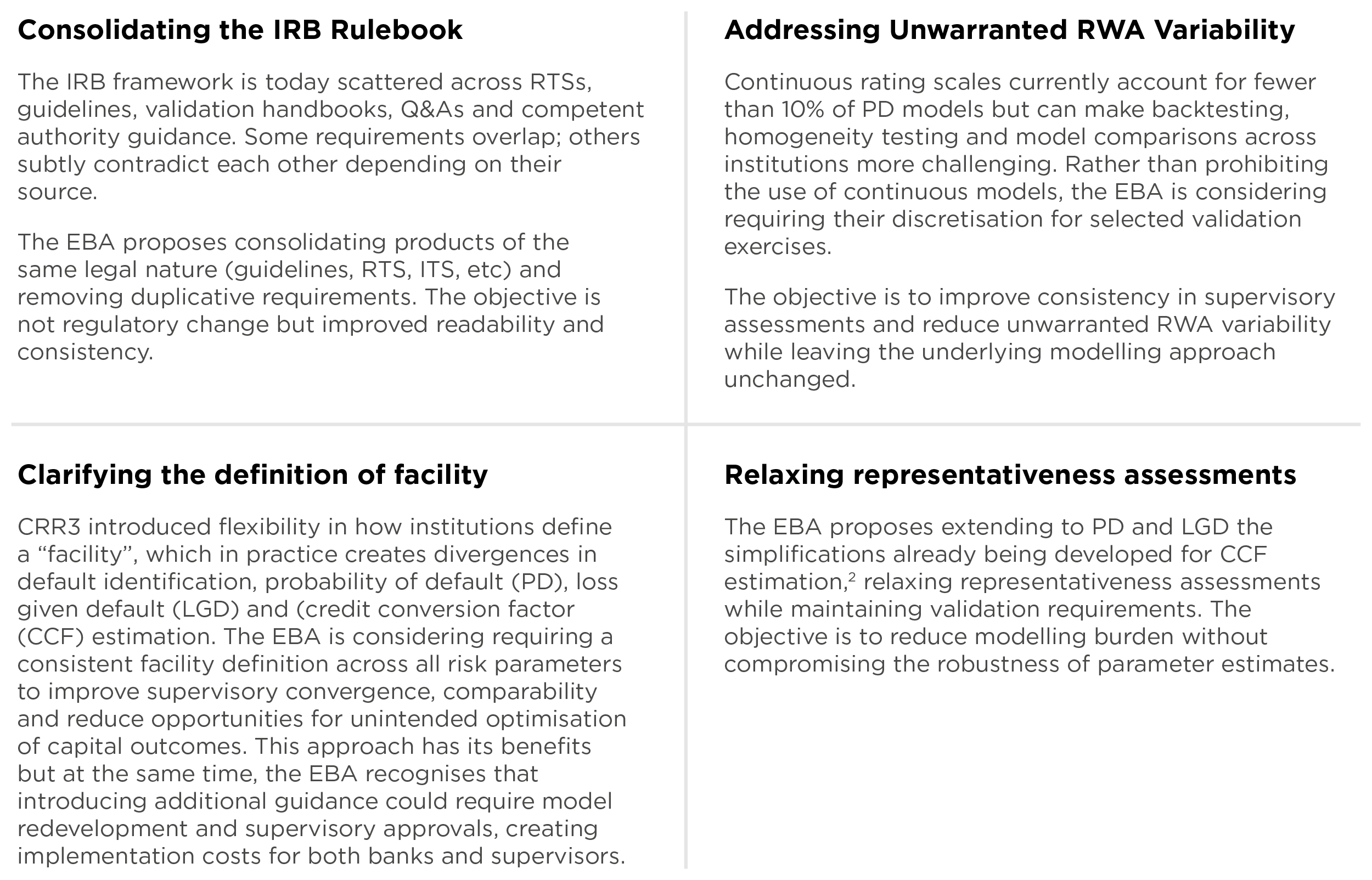
First of all, the EBA wants to increase consistency in the IRB framework and is considering revisiting several rules and definitions:
In addition, the EBA is exploring whether selected modeling requirements could be simplified while allowing institutions to remain within the IRBA framework. This evolution is of particular interest in the context of the Basel III finalization package, at a time when many institutions are reassessing their IRBA landscapes as part of broader model revision programs and Permanent Partial Use (PPU) strategies.
Rather than forcing a choice between maintaining a fully-fledged IRBA framework or reverting certain portfolios to the standardized approach, EBA is considering simplified fallback treatments for specific modeling components where implementation and supervisory effort may outweigh the additional risk sensitivity achieved.
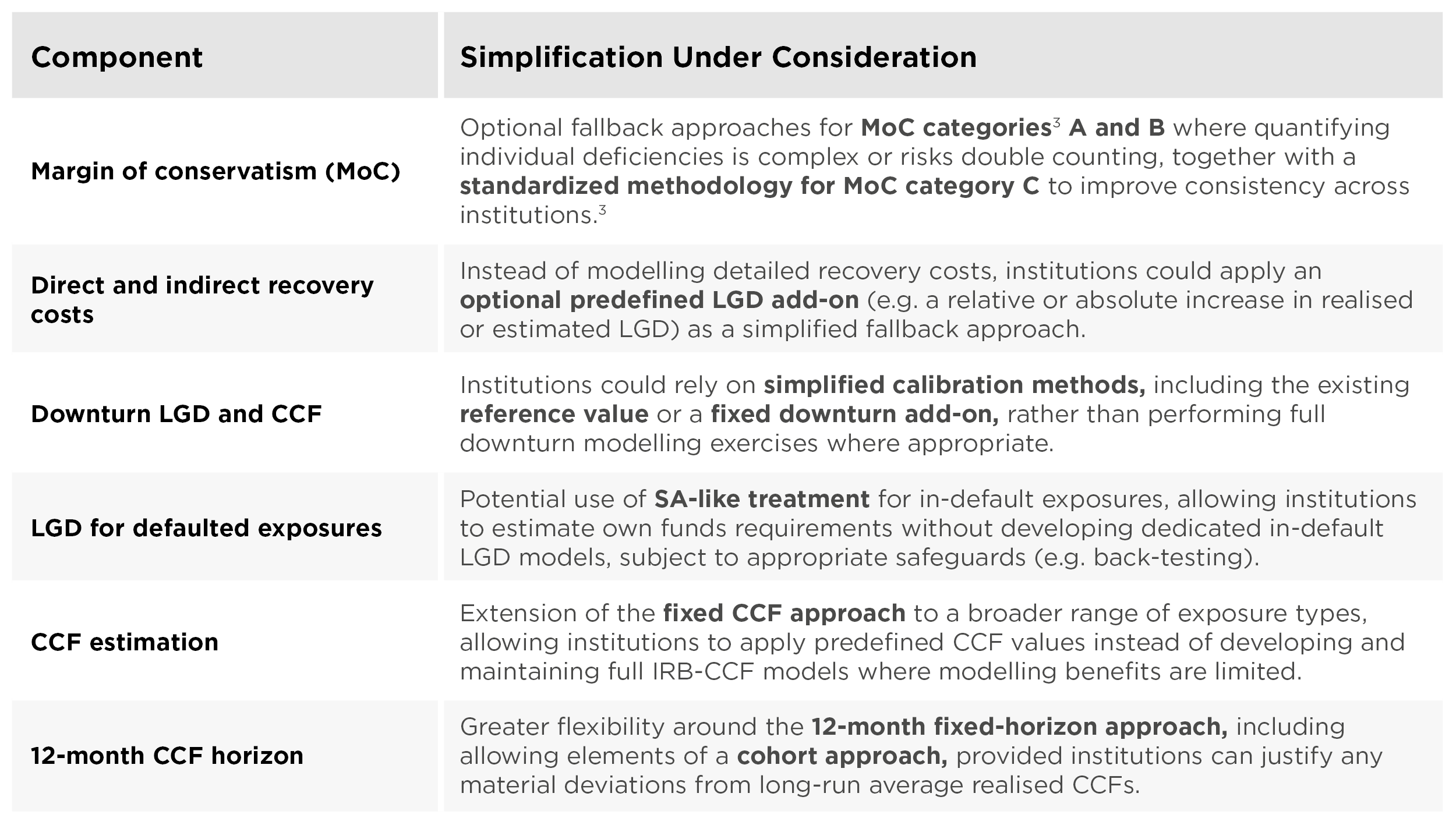
Several of the proposals amount to replacing highly granular institution-specific modeling exercises with standardized conservative treatments or simplified methodologies.
The table below sets out the modelling component under consideration and the proposed simplification approach for each.
These approaches would remain optional and are intended to complement existing methodologies rather than replace them. For IRB institutions, they represent one of the clearest examples of how the EBA is seeking to apply proportionality within the credit risk framework.
The discussion paper should be viewed as part of the EBA's broader review of the credit risk framework following CRR3 and the Basel III finalization package. Together with initiatives such as the Guidelines on IRB Credit Conversion Factors (CCF) and the draft Regulatory Technical Standards (RTS) on Permanent Partial Use (PPU), it reflects a wider effort to simplify selected IRBA requirements while preserving prudential robustness. It also complements broader simplification and efficiency initiatives from a supervisory perspective, including the EBA's draft RTS on material model changes and the ECB's ongoing work to streamline the approval process for internal model changes.
For banks, this reinforces the importance of understanding where existing processes, models and controls continue to deliver value and where simplification opportunities may emerge.
The strategic question for institutions is not simply whether to simplify, but where simplification creates optionality and where it creates constraint. Capco supports institutions in making that assessment, helping risk, finance and reporting functions work align with regulatory expectations as the framework evolves.
Contact us to discuss how we can assist your organization with translating regulatory developments into practical implementation strategies.
This article is based on the EBA Discussion Paper Simplification and Assessment of the Credit Risk Framework (EBA/DP/2026/01), published on 9 February 2026. The consultation closed on 10 May 2026. The proposals remain subject to consultation and do not represent final EBA policy or binding regulatory requirements.
The part 3 of this series will explore ESG reporting, stress testing and FINREP (financial reporting standards), as part of the EBA's reporting reform.
References
1 Discussion on the simplification and assessment of the credit risk framework | European Banking Authority
2 In 2025, the EBA consulted on draft guidelines on the methodology to estimate and apply credit conversion factors under the Capital Requirements Regulation.
3 MoC categories: Category A relates to data and methodological deficiencies, Category B to additional uncertainty arising from process or environmental changes and Category C to the model's general statistical estimation error.
To find out more about working with Capco and how we can help you overcome any potential challenges, contact our experts or subscribe for the latest insights below.

