

Executive summary
Liquidity is moving faster. Client behavior is becoming more responsive. Treasury and Risk need a shared forward view.
For many years, liquidity management has been anchored in funding structure, regulatory ratios and contingency planning. Those disciplines remain necessary. What has changed is the speed at which client decisions can translate into balance-sheet movement. The 2023 banking turmoil showed that severe deposit outflows can develop within days and materially exceed standard liquidity assumptions, with digital access, concentrated funding and negative media coverage acting as accelerants.1,2
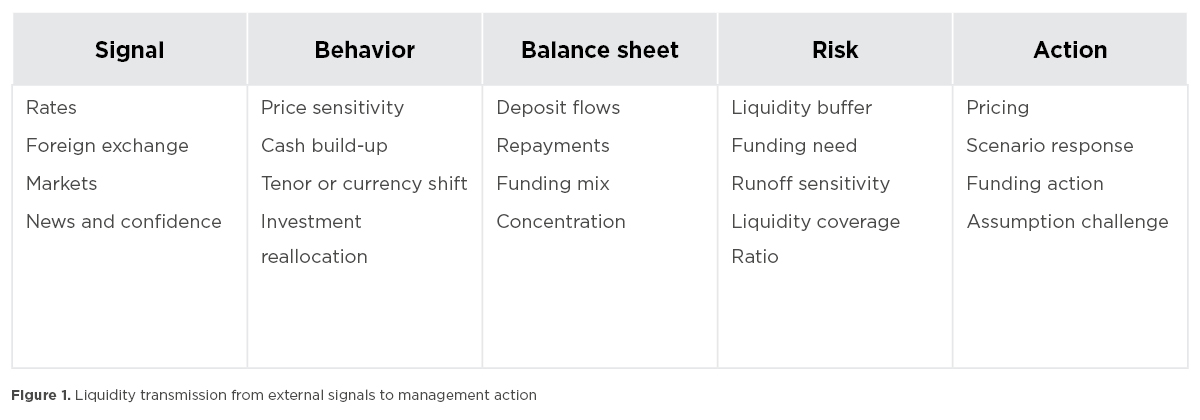
For banks, the issue is broader than bank runs. Rates, foreign-exchange movements, asset prices, investment alternatives and confidence continuously change the economics of holding cash. The relevant question is therefore no longer only how much liquidity the bank has today. It is how external signals may alter client behavior, how those responses may affect the balance sheet, and how quickly Treasury and Risk can turn that information into scenarios.
Liquidity Intelligence is the capability that connects those layers. It combines behavioral modelling, external signal interpretation and scenario simulation in a shared decision-support layer. The objective is not a single prediction of future liquidity. It is earlier recognition of changing behavioral regimes and faster, more disciplined scenario analysis.
The core proposition
Liquidity is becoming more behavioral
Deposits remain central to bank funding, but product labels no longer say enough about their stability. The same account can behave very differently depending on client segment, balance size, channel, alternatives, currency exposure and the market regime. Deposit betas are useful because they show how quickly pricing responds to policy rates, but they are not a complete model of funding quality. The deeper question is how client incentives and decision patterns translate into flows.2,3
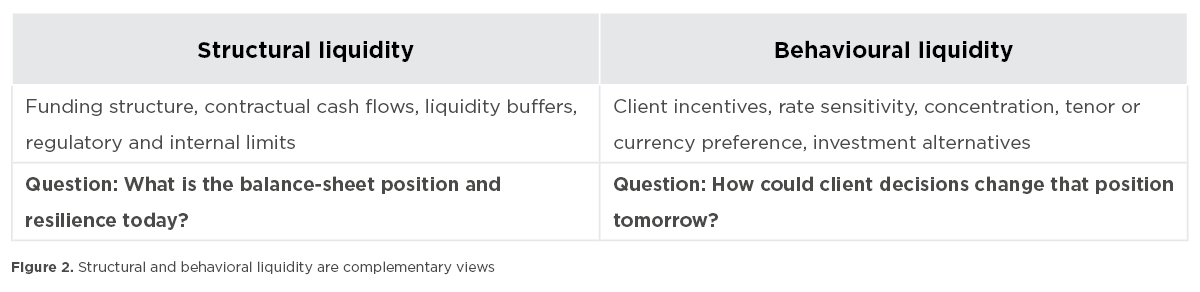
This creates a second layer of liquidity management. The structural layer remains the foundation: contractual cash flows, funding composition, regulatory ratios, buffers and contingency plans. The behavioral layer asks how quickly those positions may change when clients react to price, markets or confidence. The two layers need to be governed together.
External signals reach liquidity faster
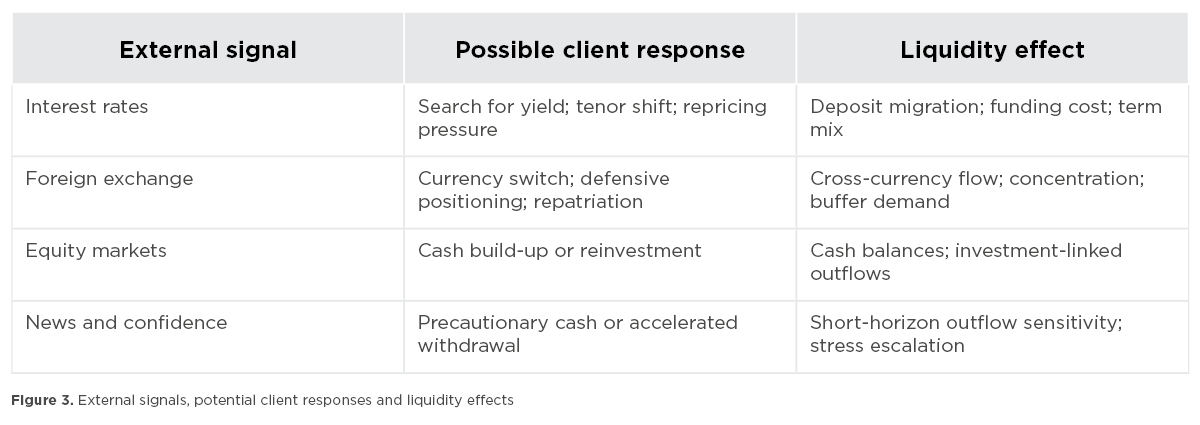
Interest rates remain the most visible external trigger, but they are only one part of the map. Foreign-exchange moves change the economics of holding liquidity in one currency rather than another. Equity markets influence whether clients retain precautionary cash or redeploy it. Geopolitical events and news flow can change confidence before the effect appears in internal bank data. The important shift is not that these variables are new. It is that they can reach client decisions faster than many liquidity processes were designed to capture.
Foreign exchange deserves particular attention because it is both a market variable and a behavioral signal. Large currency moves change relative yields, purchasing power and the perceived safety of liquidity held in different currencies. For banks with internationally oriented private and corporate clients, foreign exchange can therefore become a behavioral trigger, not only an accounting or transfer-pricing variable.
One mechanism, different banking models
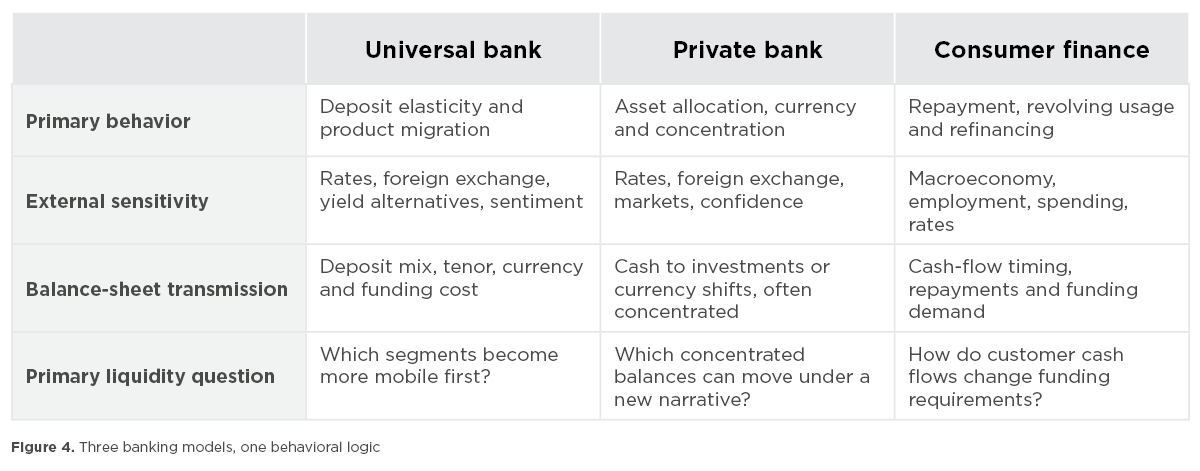
The transmission channel differs across banking models, but the behavioral logic is the same. External conditions change client incentives; client decisions alter cash flows; those movements affect funding, buffers and stress assumptions. What changes is the dominant behavior that each business model must understand.
From forecasting to scenario intelligence
Static averages remain useful baselines, but they are weakest when relationships move. The bank should not try to predict one deterministic path for liquidity. It should understand which scenarios are becoming more plausible, which segments are exposed, how assumptions behave under stress and where management attention is required first.
The objective is not prediction
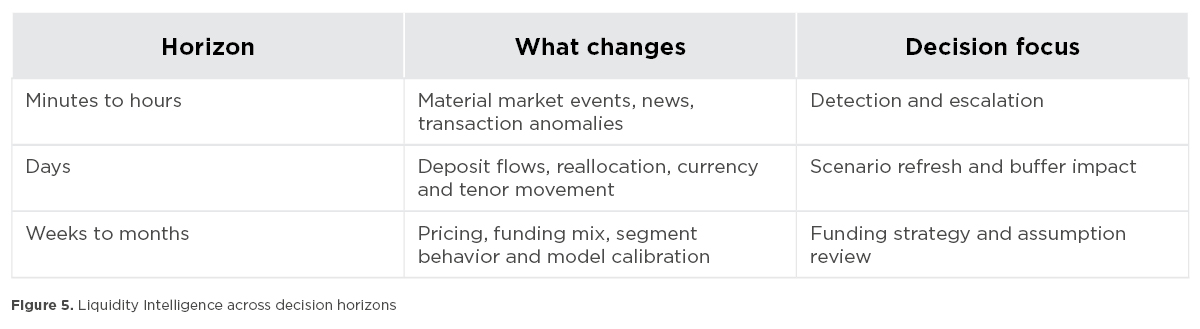
How AI enables Liquidity Intelligence
Artificial intelligence matters because the liquidity problem spans structured and unstructured evidence and because the workflow needs to remain current as conditions change. No single model should own the answer. The stronger design separates quantitative modelling, external interpretation and orchestration, with explicit controls around each layer.
The design principle is separation of responsibilities. Generative models should not replace quantitative behavioral models; they should translate external information into structured scenario inputs. Agents should not make autonomous funding decisions; they should orchestrate the workflow, keep evidence current and route decisions to accountable humans. This is consistent with the broader direction of financial-sector artificial intelligence governance, where model, data, technology, third-party and operational controls remain central.4,5
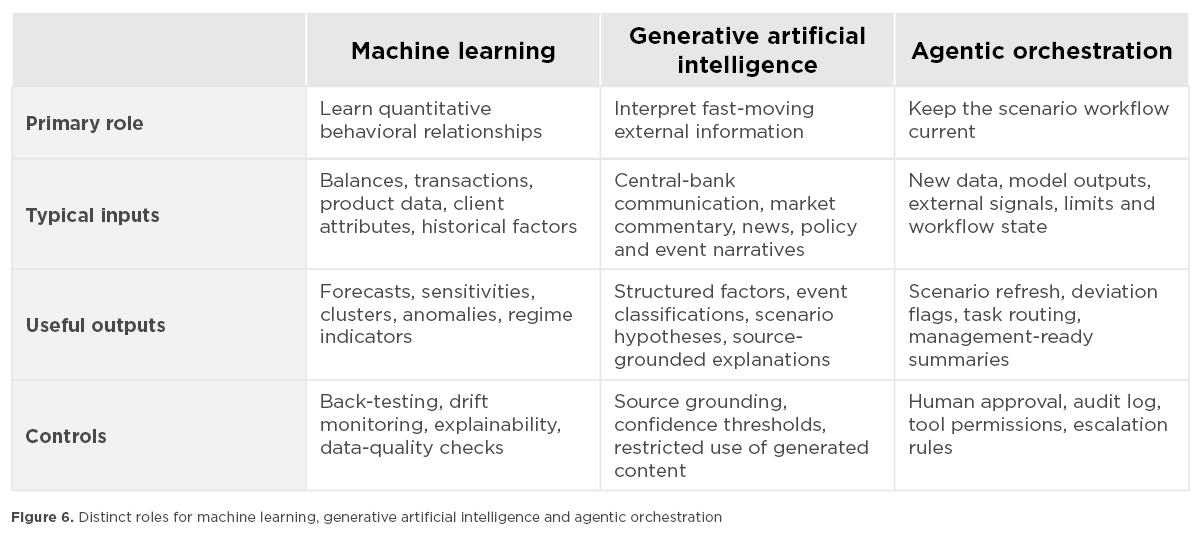
The design principle is separation of responsibilities. Generative models should not replace quantitative behavioral models; they should translate external information into structured scenario inputs. Agents should not make autonomous funding decisions; they should orchestrate the workflow, keep evidence current and route decisions to accountable humans. This is consistent with the broader direction of financial-sector artificial intelligence governance, where model, data, technology, third-party and operational controls remain central.4,5
Human judgement remains central
From signals to decisions
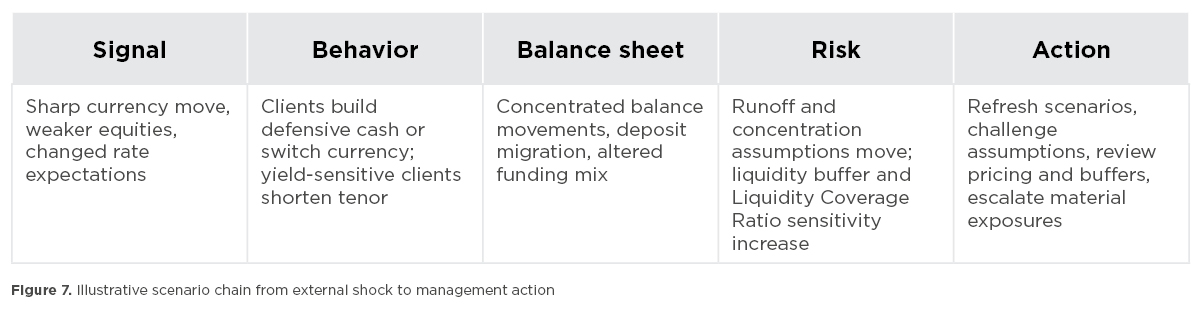
The value becomes concrete when the full chain is connected. Consider a scenario in which geopolitical uncertainty rises, a major currency moves sharply, equity markets weaken and central-bank communication changes the expected rate path. A conventional dashboard can show each variable. Liquidity Intelligence asks what the combination means for client behavior and for the bank.
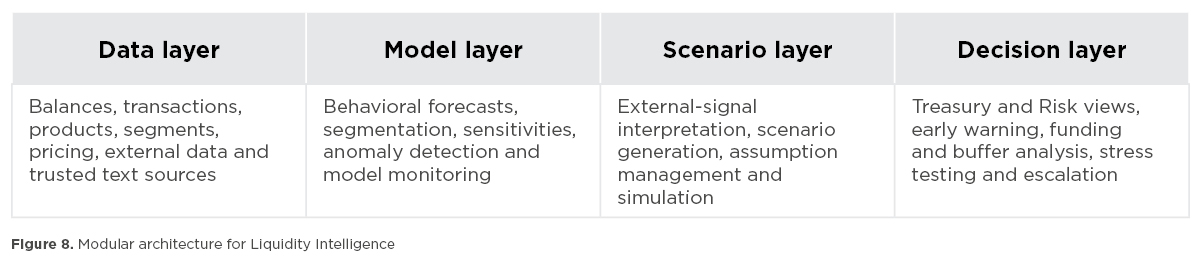
The architecture should be modular because the best model depends on the institution, the data and the behavioral problem. The bank should be able to change a forecasting technique, a source or an orchestration component without redesigning the entire capability. What remains stable is the contract between layers: trusted inputs, explicit assumptions, reproducible scenarios and auditable outputs.
Governance by design
Governance should be embedded across the architecture rather than added as a separate control layer. Each component therefore needs explicit controls for evidence, assumptions, model performance and decision rights:
- Source grounding for external information and generated explanations
- Versioned assumptions so Treasury and Risk can see what changed and why
- Model monitoring and back-testing for quantitative components
- Human approval for material scenario changes and management actions
Liquidity Intelligence in practice
Liquidity Intelligence should not be presented as a single forecasting model or another Treasury dashboard. It is a shared intelligence layer that brings monitoring, behavioral forecasting, external signals, scenario analysis and liquidity-risk implications into one operating view.
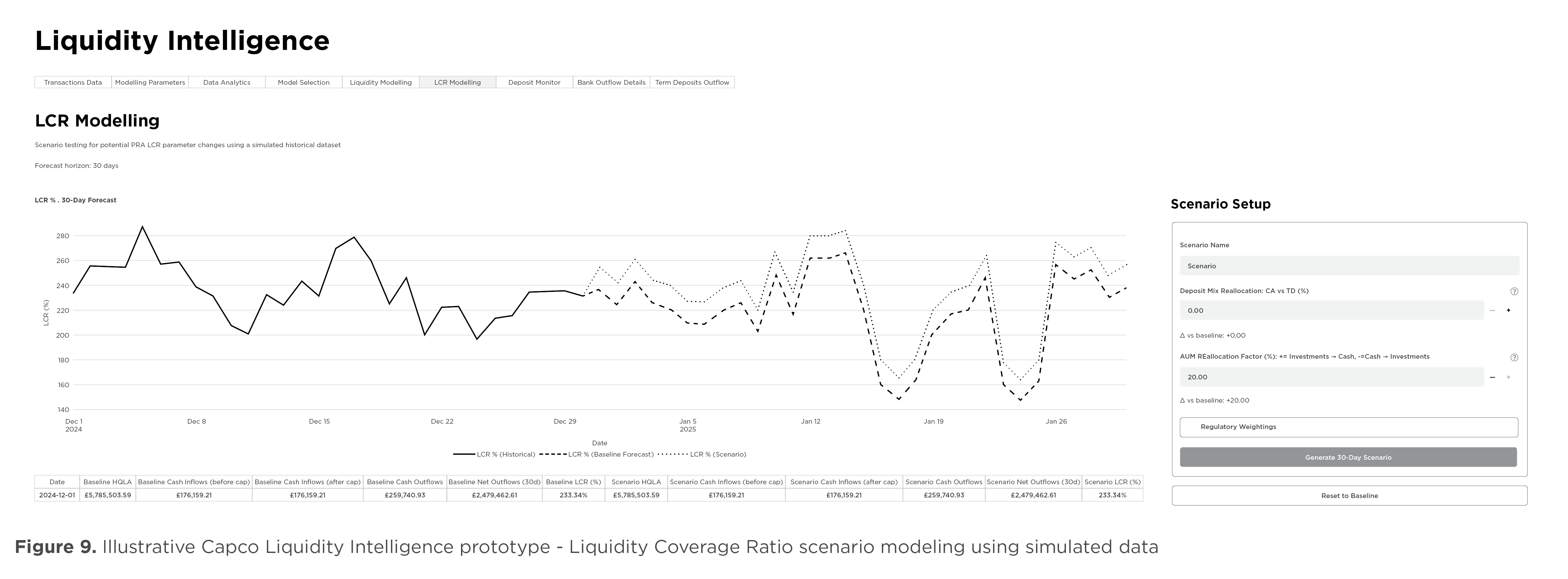
Forecasting with context Internal balance-sheet and transaction data remain the quantitative core. External factors add context when the relationship between past behavior and future behavior is changing. At the learning stage, models identify patterns, sensitivities and anomalies; at the interpretation stage, external information is converted into structured scenario inputs.
Decision support, not reporting Users should be able to change assumptions and see how the scenario propagates through balances, funding needs, liquidity buffers and the Liquidity Coverage Ratio. That allows Treasury and Risk to challenge not only what may happen, but also how their own modeling framework responds when conditions change.
One operating view for Treasury and Risk Treasury sees pricing, funding options and buffer usage. Risk sees concentration, runoff, scenario severity and assumption robustness. The value of Liquidity Intelligence is that both functions work from the same scenario evidence while retaining their distinct responsibilities.
Capability, not product label
Our approach
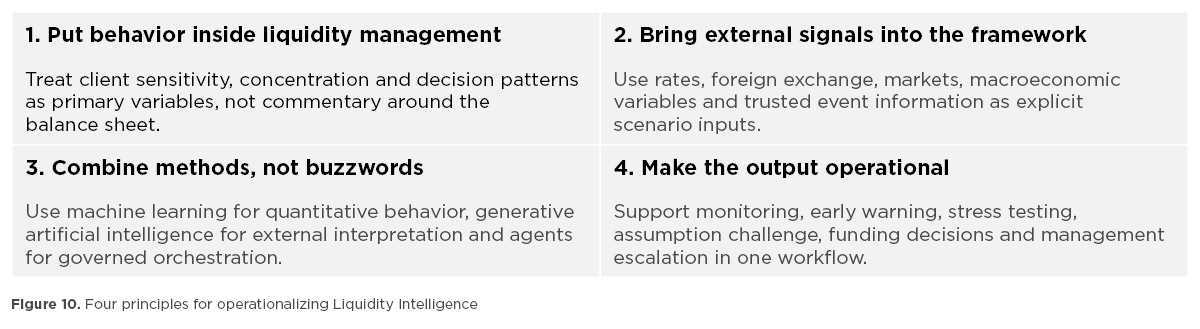
What we propose is not a better Treasury dashboard in isolation and not a theoretical Risk framework detached from execution. It is a joint Treasury-Risk capability built around behavioral insight, external-factor awareness and scenario discipline.
Conclusion
Liquidity management has entered a more behavioral phase. Structural liquidity remains the foundation, but the speed and sensitivity of client decisions increasingly determine how quickly a stable balance sheet can change. Rates, foreign exchange, asset prices and confidence do not matter only as market variables. They matter because clients respond to them differently across segments, products and currencies.
This is why Treasury and liquidity-risk management increasingly need a shared behavioral and scenario view. Machine learning provides quantitative discipline. Generative artificial intelligence expands the information set. Agentic orchestration shortens the distance between a signal, a scenario and a management view. None of these technologies replaces judgement. Their role is to make judgement more timely, structured and defensible.
Liquidity Intelligence is therefore better understood as a scenario-intelligence layer than as a forecasting engine. Where liquidity can become more mobile before it becomes visibly unstable, the ability to see change early, challenge assumptions quickly and respond in a coordinated way is becoming a core capability of prudent balance-sheet management.
References
1. Basel Committee on Banking Supervision (2024), The 2023 banking turmoil and liquidity risk: a progress report, Bank for International Settlements, 11 October 2024.
2. Blickle, K., Li, J., Lu, X. and Ma, Y. (2025), The Rise in Deposit Flightiness and Its Implications for Financial Stability, Federal Reserve Bank of New York, Liberty Street Economics, 10 July 2025.
3. European Central Bank (2024), Financial Stability Review, May 2024, section on bank deposit rates and deposit betas.
4. Crisanto, J. C., Leuterio, C. B., Prenio, J. and Yong, J. (2024), Regulating artificial intelligence in the financial sector: recent developments and main challenges, Financial Stability Institute Insights No 63, Bank for International Settlements.
5. Bowman, M. W. (2025), Artificial intelligence, fintechs, and banks, speech hosted by the Bank for International Settlements, 9 April 2025.
