The impact of Generative AI on the workforce cannot be viewed simply as another technology cycle. It is a redesign of work itself. Every stage of the employee lifecycle is being reshaped and the way value is created, measured and sustained in organizations is being redefined.
Generative AI has moved rapidly from novelty to embedded infrastructure in under three years. From a workforce perspective, the International Monetary Fund estimates that nearly 40% of global employment is exposed to AI, with significantly higher exposure in advanced economies.¹ The World Economic Forum projects that 44% of workers’ core skills will change by 2027, while tens of millions of roles will be restructured through automation and augmentation.² The scale of disruption is systemic.
By 2025, the narrative around workforce reductions began to shift from post-pandemic labor corrections to what were framed as structural AI pivots. By 2026, a dual-layer trend has emerged: organizations are using AI as a catalyst to prune legacy technical debt and 'middle-management layers’, before reinvesting those savings into higher-cost AI specialized talent.
However, there is a growing gap between AI ambition and tangible workflow redesign. While AI is materially affecting every stage of the employee journey, transformation is moving faster than organizational adaptation, leaving many firms unable to convert AI-driven change into measurable, sustained value. Bridging this gap will require more than incremental AI adoption. It demands a fundamental redesign of how work is structured, performed and governed.
AI as a workforce redesign moment
The changes and challenges associated with embedding Generative AI (GenAI) begin with the first key touchpoint of the employee lifecycle: attracting and assessing talent.
Recruitment and assessment: governance, trust and the hiring arms race. GenAI is reshaping recruitment on both sides of the market. Candidates use generative tools to draft CVs, optimize applications and rehearse interview responses while employers deploy AI-driven screening and assessment systems to filter large applicant pools.
Rising candidate fraud linked to GenAI technologies is a growing concern, however, and the result is an escalation cycle.
3 Polished artifacts no longer reliably indicate capability, and this dynamic erodes trust in the hiring process. The solution is redesign. Applied capability, demonstrated through live simulations, case work and contextual problem-solving, will become more important than static credentials.
Early career development: the talent paradox. GenAI is being used to automate tasks that traditionally built early-career capability- research synthesis, first-draft writing, data analysis and coding support. These activities formed the ‘apprenticeship’ layer through which junior employees developed judgment.
4 At the same time, demographic shifts are accelerating. Advanced economies are facing sustained retirement pressures, accelerating the drain of experienced employees from organizations.
Organizations are thus losing institutional knowledge while simultaneously choking off the pipeline of junior talent that would replenish it. This creates a paradox: fewer entry-level opportunities, greater demand for experienced integrators and shrinking time horizons for necessary skill development.
The skills most exposed to automation are predictable cognitive tasks, including standardized drafting, data reconciliation, reporting updates and routine code generation. The skills rising in value are contextual judgment, workflow design, systems thinking and human coordination. The workforce of the future will be less about isolated roles and more about capability architecture.
Day-to-day work and performance: ambiguity in the age of augmentation. GenAI changes not only what work is done, but how performance is perceived. Research from Harvard Business School demonstrates that Generative AI improves productivity and quality, particularly among lower-performing professionals.
5 Output becomes faster and more standardized, compressing performance differentiation. When everyone can generate executive-ready outputs with (AI) assistance, actual underlying capability becomes harder to detect and measure. Organizations risk rewarding AI fluency rather than strategic judgment.
Moreover, the productivity gains from GenAI are leading to leaner team structures with more work loaded onto employees, leading to increased strain from additional workloads. Efficiency gains, if not intentionally reinvested, simply accelerate workload expansion rather than enabling innovation. AI-generated content often requires review and correction, creating rework. This creates a hidden productivity tax, eroding the gains expected from embedding AI in organizations.
6
These competing dynamics show the complex challenges of embedding AI successfully to maximize value and innovation.
Experience and engagement: psychological strain and cultural dissonance. GenAI adoption is not just operational, it is psychological. As generative systems take on cognitive tasks, once associated with expertise, many employees experience a perceived threat to competence and identity. What was previously a source of differentiation becomes machine-assisted, reshaping how individuals perceive their own value.
Stanford’s AI Index highlights the increasing complexity of human-AI interaction, including oversight and verification demands.
7 AI does not eliminate cognitive effort; it redistributes it. Employees must now evaluate outputs, detect hallucinations and assume accountability for systems they do not fully control. This introduces cognitive strain rarely measured in productivity dashboards.
Employee experience and change fatigue are seen as leading transformation risks. When organizations assume that AI will increase speed and efficiency, performance expectations rise accordingly. Without parallel changes in culture, role clarity and support, this pressure intensifies, leading to disengagement and erosion of trust.
Sustainable AI transformation therefore requires more than automation. Human-first AI adoption requires work to be thoughtfully redesigned around autonomy, mastery and purpose, driving stronger engagement and more sustainable impact than automation-first approaches.
Expertise and long-term value: digital doppelgangers. As AI systems are trained on organizational data, including outputs of high-performing employees, expertise can be captured, replicated and scaled. When an employee’s writing style or methodology informs a generative model, that capability persists beyond the individual. This raises important questions about who owns that derivative capability and who benefits from the long-term value it generates?
In knowledge-intensive sectors, AI exposure is redefining the traditional path from novice to expert. Foundational tasks are becoming automated or AI-assisted, and expertise is increasingly codified into systems rather than residing solely in human experience.
Organizations must rethink how expertise is developed, how knowledge is codified and how AI-enabled value is shared. The workforce model of the future will shift from a traditional hierarchy of accumulated experience to a ‘dynamic capability network’, where human judgement, institutional knowledge and intelligent systems continuously interact to create value.
Organizational design: from jobs to work systems. AI-first adoption often fails because technology is layered onto legacy structures without rethinking how work is organized. Incremental automation preserves outdated role definitions and limits impact. Leaders must move beyond automating tasks within existing jobs and instead prepare for job and workflow redesign.
True value emerges when organizations redesign work systems: mapping workflows at the task level. This means clarifying human versus machine accountability, reinvesting productivity gains into innovation and measuring wellbeing alongside efficiency. At the same time, organizations must guard against cognitive atrophy by ensuring employees retain a baseline understanding of the task being automated, enabling effective oversight, quality control and emergency intervention as required.
AI workforce maturity framework
Against this complex backdrop, our AI workforce maturity framework helps organizations benchmark their current state and build a practical plan for successfully transforming their workforce to deliver sustained value creation (see Figure 1). The framework assesses organizations across a range of dimensions from role definition, capability building and motivation through to trust and governance. It provides a structured lens to benchmark organizational maturity in successfully embedding AI across the workforce.
One end of the maturity curve is Level 1, where AI use may be emerging but not yet embedded within operating models. At the other end of the curve is Level 5, which applies to a human-centric AI enterprise where AI is governed with clear accountability and intentionally deployed to maximize human capability and workforce impact.
While our framework assesses organizations across this spectrum, it is important to recognize that maturity is not linear. Organizations can regress from Level 3 to Level 1 following shadow AI data breaches, legal crises triggered by hallucinations, or failure to keep pace with emerging technologies (e.g. Agentic AI). Sustained maturity requires a ‘Continuous Transformation Loop’ – a structured cycle of human oversight, monitoring and auditing of AI systems that ensures, as these systems become more capable, that human judgement remains active and effective rather than being gradually eroded.
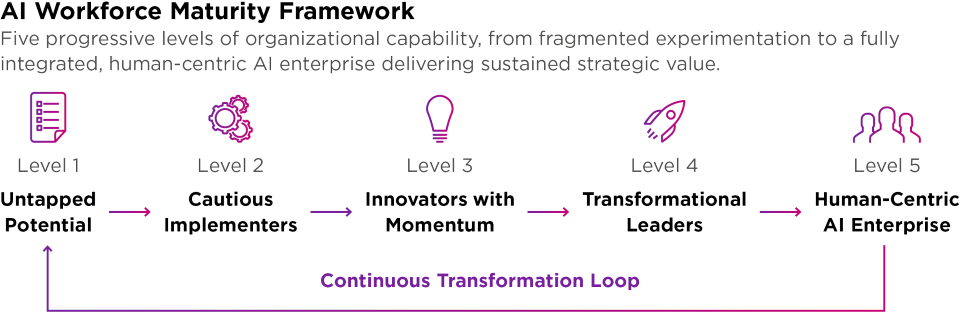 Figure 1
Level 1: Untapped Potential.
Figure 1
Level 1: Untapped Potential. At this level, AI use is informal and opportunistic, driven by individual experimentation rather than organizational design. Motivation to adopt AI may be low, capability unevenly developed and trust will be fragile. Both the opportunities and governance risks associated with unmanaged AI experimentation are underestimated by organizations at this stage.
Level 2: Cautious Implementers. Organizations at this level embed AI within specific functions, primarily supporting discrete tasks such as drafting, summarizing or analysis. While efficiency gains emerge, integration into end-to-end workflows is limited. Capability improves, but motivation and trust vary across teams. AI is treated as a productivity tool rather than a workforce redesign lever.
Level 3: Innovators with Momentum. AI is embedded across processes rather than being limited to isolated tasks. Human-AI roles are clearly defined, governance frameworks are mature and AI literacy expands beyond tool use to include oversight and judgement. Motivation strengthens as value becomes tangible and trust begins to stabilize. At this level, organizations have moved from experimentation to intentional design.
Level 4: Transformational Leaders. The organization redesigns work systems around skills and workflows rather than static roles. Continuous reskilling builds capability at scale and productivity gains are invested into innovation and capacity building. Trust is no longer based on isolated pilots or experimentation; it is embedded in governance, performance management and leadership accountability. AI is not treated as a separate tool layered onto existing processes. It is integrated into how work is designed executed and measured across the organization.
Level 5: Human-Centric AI Enterprise. The North Star is the Human-Centric AI Enterprise, where AI governance is embedded at the leadership level, with clear accountability for ethical, operational and workforce impact. The organization continues to reassess the optimal balance between human judgment, AI execution and collaborative intelligence. Motivation, capability and trust are reinforced through ongoing evaluation, redesign and reinvestment, enabling sustained resilience and long-term workforce capability building rather than a one-off transformation.
The leadership imperative
AI, including GenAI and emerging agentic systems, will not eliminate all work, but will redefine some work and create new work. The defining capability of the next decade will not be automation but organizational adaptability, the ability to redesign systems, protect human capital, and evolve performance models in parallel with technology.
AI transformation is not about replacing people. It is about redesigning the conditions under which people create value.
At Capco, we help organizations build skills-based models that harness emerging technologies to maximize productivity, unlock human capital and strengthen long-term resilience. Contact us to unlock the full potential of your workforce and build a future-ready organization.
References
1 https://www.imf.org/en/Publications/Staff-Discussion-Notes/Issues/2024/01/14/Gen-AI-Artificial-Intelligence-and-the-Future-of-Work-542379
2 https://www.weforum.org/reports/the-future-of-jobs-report-2023/
3 https://www.gartner.com/en/newsroom/press-releases/2026-01-12-gartner-identifies-the-top-future-of-work-trends-for-chros-in-2026
4 https://hbr.org/2025/01/9-trends-that-will-shape-work-in-2025-and-beyond
5 https://www.hbs.edu/faculty/Pages/item.aspx?num=64700
6 https://www.thehrdigest.com/redos-and-reworks-ai-output-quality-issues-dilute-productivity-gains/
7 https://aiindex.stanford.edu/report/