


Click here to view the German Version
The Financial Data Access (FiDA) Regulation is not simply another regulatory initiative—it is a profound structural shift for the European financial sector. The EU aims to finally close the persistent gap between technological capability, data availability, and the realities of market practice. FiDA introduces a broader and more binding framework on its way to Open Finance: data access, interoperability, and customer sovereignty become enforceable obligations rather than optional enhancements. This article explains how to integrate FiDA into a financial organization’s business model.
Introduction
The Financial Data Access (FiDA) framework sets ambitious new standards for the financial sector on its path toward Open Finance. As a cornerstone of the EU’s strategy to evolve the internal market into a data-driven, customer-centric financial ecosystem, FiDA emphasizes giving customers greater control over their personal data, ensuring secure data exchange, and fostering data-driven innovation. It also aligns with parallel EU initiatives such as the Payment Services Directive (PSD3), the Payment Services Regulation (PSR), and the European Digital Identity (EUDI) to form a coherent vision of the future financial landscape.
However, FiDA is not a sure-fire success and needs its own structure within the business model. The complexity of FiDA requires a holistic approach that combines strategic, organizational, procedural, technical, and legal aspects. In the following, we will show you how FiDA can be implemented in four partially overlapping phases, from the strategic decision through to implementation, ongoing optimization and monetization.
FiDA focus areas
Financial Data Access obliges financial institutions in their role as data holders to provide retail customers and SMEs with product-related data sets in real-time via a consent dashboard. This requires investment in the modernization of IT architecture and data management, taking into account parallel regulations such as PSD3, PSR, and eIDAS (electronic ID).
In addition to the mandatory provision of data, FiDA gives financial market participants the option of becoming data users, thus receiving data from end-customers and processing it in a value-adding manner. The processing is expected to be carried out via group contractual agreements, known as financial data sharing schemes (FDSS), which must include a minimum number of customers per product.
With the financial data sharing schemes, FiDA establishes, for the first time, an institutional coordination model for Open Finance. Each FDSS must:
- Represent at least 25% market share in a given segment
- Bind data holders and data users on a mandatory basis
- Define joint governance, standards, and operating models.
Membership is mandatory; the largest participants are reported to the supervisory authorities. In doing so, FiDA prevents a renewed fragmentation of the sort seen under PSD2 and creates a consistent operating system for the European financial data market.
FiDA target operating model – structured, phased and scalable
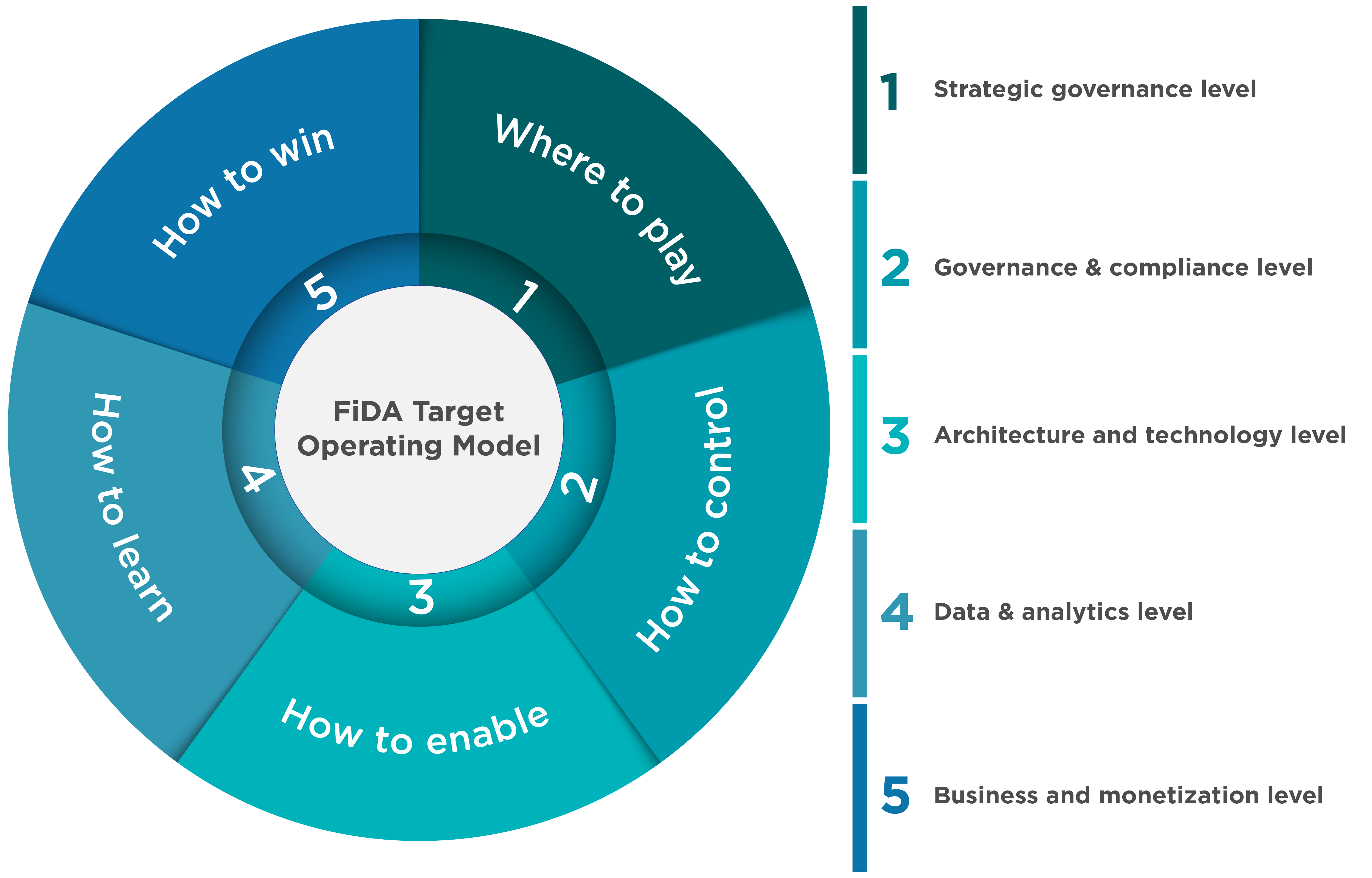
The FiDA target operating model (TOM) forms the conceptual foundation for embedding FiDA strategically, organizationally and technologically within an institution. It links steering directions with clear principles of accountability and architecture, thereby creating prerequisites for scalable implementation.
The following illustration shows the logical interconnection of the five central steering principles (where to play, how to control, how to enable, how to learn, how to win) with the respective organizational levels of an institution - strategic decision-making, governance, technology and monetization:
The graphic underlines that FiDA is not a linear process, but a cyclical steering model that connects strategic decisions, operational capabilities and continuous learning.
The four phases of FiDA implementation
Building on this conceptual model, we have developed a phased approach that takes institutions from strategic positioning all the way to monetizing data-driven services.
Phase 1: preparation and strategic orientation
This phase creates strategic clarity, defining role, direction and the starting point:
- Screening of all relevant products and data sources
- Assessment of data quality and availability
- Analysis of market potential and customer needs
- Definition of the target FiDA role (holder, user, FISP, orchestrator)
- Development of the FiDA target vision and a coherent roadmap.
Phase 2: governance, architecture and scheme enablement
This phase forms the institutional and technological backbone of implementation:
- Establishment of cross-functional governance structures
- Design of the target architecture (APIs, consent management, data governance)
- Integration of DORA and EUDI requirements
- Participation in FDSS exploratory talks and active contribution to standardization
- Capability building and internal enablement.
Phase 3: implementation and market launch
This phase demonstrates technical capability, market readiness and compliance:
- Development of a EUDI-compatible consent and identity framework
- Setup of a developer portal with sandbox environment and API catalog
- Wave-based product integration (including audit, testing and certification)
- Introduction of a FiDA monitoring dashboard
- Implementation of a continuous improvement process.
Phase 4: ecosystem, monetization and sustainable value creation
FiDA does not end with the provision of data – it starts there. Economic success arises when institutions generate continuous customer benefit, trust and revenue from data:
- Development of premium APIs and value-added services
- Monetization via API subscriptions, insights-as-a-service and cross-selling
- Building a partner and developer ecosystem
- Establishment of a FiDA operations center (security, compliance, performance).
The FiDA transformation – more than a project, an organizational shift
Against the backdrop of these structural and technological requirements, it becomes clear that FiDA is a profound organizational transformation. Experience from PSD2, DORA, PSR and EUDI shows that regulatory initiatives rarely fail because of their nature, but because of the lack of prioritization, unclear governance and siloed thinking.
FiDA therefore requires:
- A clear ambition and role choice
- Cross-functional governance instead of silo-based logic
- An architecture that combines modularity, interoperability and security
- Active participation in FDSS instead of simply adopting external standards
- The development of internal capabilities instead of relying on outsourcing.
FiDA is complex and cannot be implemented by a single department. Rather, a transformation office is needed to address all aspects from a single source and in a coordinated manner. Data, its quality, its provision and its processing play a predominant role here.
Only a strategically driven transformation approach can generate the impact FiDA is designed to enable. The current delay in the legislative process is a blessing, providing time for this profound change.
How Capco can help
Capco can support financial institutions with a FiDA starting point assessment, an impact & opportunity map and a data readiness & quality assessment to help gain full transparency about their FiDA starting point and next steps. Contact us to find out more.
Related Content

Contact us
To find out more about working with Capco and how we can help you overcome any potential challenges, contact our experts via the form below.